
A Resource Bridging Academics to Practice
The Preparing School Interpreters (PSI) Project supported Scholars not only through their academic preparation during the School Interpreting Series (SIS) curriculum but also as they transitioned into professional practice. Bridge activities and resources extended learning beyond formal coursework by providing continued opportunities for skill development, reflection, professional connection, and individualized support.
School Interpreting Support Services Hotline

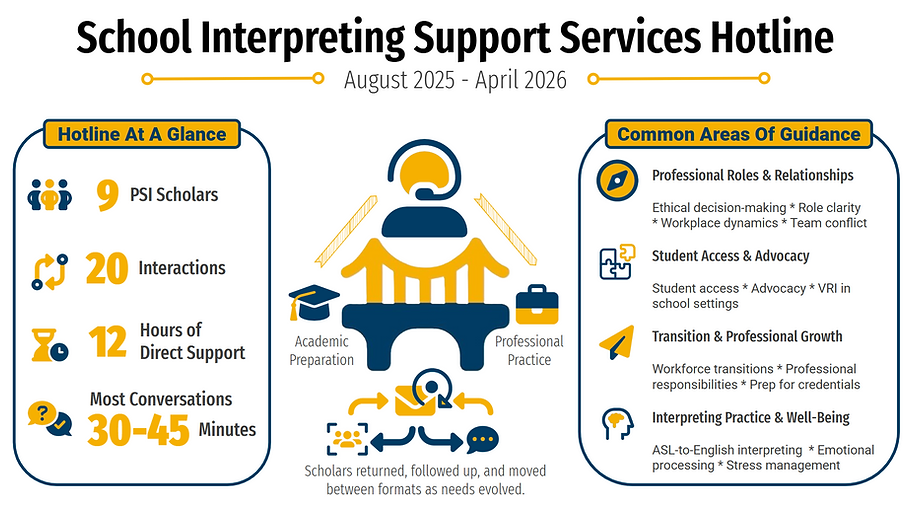
The School Interpreting Support Services (SISS) Hotline provided responsive, individualized support to PSI Scholars and Graduates navigating the complexities of school interpreting. The hotline gave them, as emerging professionals, access to professional guidance and reflective support through email and Zoom.
PSI Scholars and Graduates used the hotline to discuss workplace challenges, ethical dilemmas, role expectations, student access, assessment preparation, skill development, and the transition into professional practice. Rather than providing supervision or prescribing a particular response, the hotline helped PSI Scholars and Graduates consider the situations, explore relevant professional and ethical factors, identify resources, and determine their own next steps.
Bridging Academics to Practice
The School Interpreting Series curriculum helped PSI Scholars develop the knowledge, skills, and professional judgment needed for school interpreting. Once they entered schools, however, the PSI Scholars and Graduates encountered situations that could not always be anticipated or fully addressed within a course.

The SISS Hotline extended learning into these real-world settings. It provided a place to connect what Scholars and Graduates had learned with the questions and challenges emerging in their daily work.
Sometimes Scholars and Graduates needed information or a resource. Other times, they needed space to slow down, talk through a complex situation, and consider possible next steps. The hotline provided this continued connection between academic preparation and professional practice.
Intended Transition Point
The SISS Hotline was designed for PSI Scholars moving from academic preparation into internships, new placements, and professional employment.
Support was especially valuable when PSI Scholars:

-
Transitioned from an internship into the workforce
-
Entered a new school or educational setting
-
Encourtered uncertainty about their roles or responsibilities
-
Navigated workplace relationships or team conflict
-
Prepared for the EIPA, NIC, or BEI
-
Identified an interpreting skill they wanted to strengthen
-
Faced an unfamiliar ethical or professional dilemma
-
Needed support processing a challenging experience

Although the hotline was particularly relevant during the initial transition into practice, PSI Scholars and Graduates could return as new questions and professional development needs emerged.
Access, Communication, & Guidance
Access to the SISS Hotline was introduced across the three PSI Cohorts.
Cohort
August 2025

Cohort
December 2025

Cohort
Springtime 2026

In some cases, earlier access was provided based on individual need.
PSI Scholars and Graduates contacted the hotline through a dedicated email address. Depending on the nature of the

question, support continued through email or shifted to a scheduled Zoom conversation. Follow-up communication, research, or additional resources were provided when helpful.

Shining a light on...
Materials for the SISS Hotline

The SISS Hotline used a small collection of materials to introduce the service, explain how it worked, and support its implementation:
-
SISS Hotline announcement flyer describing its purpose
-
Introductory email to PSI Scholars
-
Dedicated hotline email address
-
Instructions for requesting support including response-time expectations, confidentiality practice, and boundaries
-
Zoom scheduling information
-
Interaction-tracking spreadsheet
Considerations for Replication
When creating a bridge between academic preparation and professional practice consider:

-
Purpose and boundaries: Clearly define the support provided and how it differs from supervision, evaluation, or counseling.
-
Access: Establish a dedicated point of contact, expected response time, and options for written or live support.
-
Trust: Create a confidential, non-evaluative space where emerging professionals feel comfortable discussing challenges.
-
Time: Plan for preparation, research, and follow-up in addition to direct support.
-
Documentation: Use a simple system to track interactions, general topics, time, and followup while protecting participants' privacy.
-
Sustainability: Identify who will maintain the support and how it can continue as participation grows.